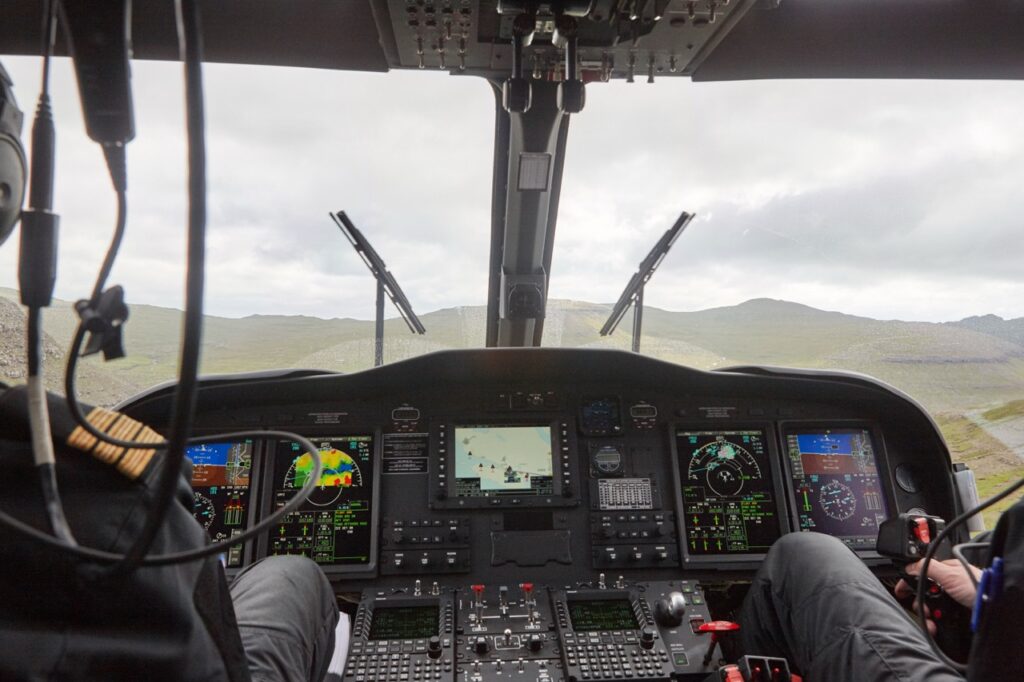
Early aircraft cockpits were defined by simplicity: a seat, a control stick, and a few analog gauges. As aviation matured through the mid-20th century, cockpits became crowded with electromechanical instruments, requiring pilots to interpret dozens of independent data points. Flying was as much instinct as it was interpretation.
Today, the cockpit is no longer a collection of instruments. It is an integrated system. Modern displays synthesize thousands of data inputs into a unified interface, reducing cognitive load while enhancing situational awareness. The pilot no longer assembles the picture; the system is designed to deliver it.
Four Decades of Cockpit Evolution
A comparison of cockpits from two combat helicopters across eras, AH-1 and an AH-64E, highlights the impact of the adoption of display systems. Integration into multifunction LRUs reduces the number of pieces of equipment by a factor of 10, but increases data availability by more than 100. Displays have become the cockpit.
| Category | 1984 Helicopter | 2026 Helicopter |
|---|---|---|
| Physical instruments | 80–120 | 5–10 |
| Data points available | ~100–200 | 10,000+ (processed) |
| Data shown at once | ~50–100 (raw) | 200–500 (filtered/fused) |
| Integration | None / minimal | Full sensor fusion |
| Interfaces | Gauges, switches | MFDs, touch, helmet display |
The shift was not incremental. It represents a fundamental change in how information is processed, prioritized, and acted upon. The reduction in hardware is matched by the exponential increase in decision-relevant data, enabled by sensor fusion and software-defined interfaces.
The evolution towards a glass cockpit was progressive, and the lasting impact on mission capabilities was equally revolutionary. The initial military standard for night vision display compliance, MIL-L-85762, was developed in collaboration with Cevians and defined the allowable near-infrared emission per display. As display technology advanced from CRTs and LEDs to monochromatic TFT-LCDs and AMLCDs, each generation introduced new optical and spectral challenges. Each display technology requires precise spectral filtering to meet strict radiance and chromaticity specifications. Historically, NVIS displays relied on specialized materials not widely available in commercial markets. Unique glass chemistries and multi-layer optical stacks were developed to achieve performance levels not required in other industries.
This level of technical sophistication and niche demand has driven the emergence of specialized providers such as Cevians, focused on mission-critical optical filtering and NVIS compliance in demanding operational environments.
Expansion of NVIS
Originally limited to cockpit environments, NVIS display technology has expanded across ground systems, auxiliary aircraft displays, and mobile mission platforms.
What began as a highly specialized solution has evolved into a broader ecosystem of applications, each with distinct technical requirements.
The expansion of applications introduces multiple layers of technical compliance depending on mission needs. Some NVIS display applications focus primarily on minimizing interference with surrounding NVG users, with limited requirements for color rendering. Others require strict chromaticity control and advanced black-level performance, including BlackBackground™ technologies.
Variation in Requirements
Not all NVIS applications require the same level of performance. Some prioritize minimizing interference with night vision goggles, while others demand strict chromaticity control and advanced black-level performance.
This variability makes system-level design critical, as display performance must be tailored to the operational environment.
It is critical for users to understand the environment in which the NVIS display will be used and how it will meet their specific requirements. To meet system performance requirements, NVIS displays need to integrate several features to ensure that near-infrared levels and chromaticity requirements are met. This includes the display’s ability to control brightness based on the mission’s settings. Systems must support low-level luminance and precise dimming ranges across varying ambient lighting conditions.
Selecting an NVIS Display
Selecting an NVIS display requires alignment between system requirements and verified performance capabilities. System engineers must define precise performance requirements and validate that display providers can meet them under real-world conditions.
Selecting an NVIS display requires:
- Clearly defined operational environment (cockpit, ground, multi-user NVG).
- Verified spectral filtering performance (near-IR suppression).
- Stable chromaticity across brightness levels.
- Wide dimming range for variable lighting conditions.
- Proven testing capabilities in low-level radiance measurement.
Conclusion
As avionics systems continue to evolve toward greater autonomy and increasing data density, the role of the NVIS display is no longer secondary. It is foundational.
The challenge has shifted. It is no longer about accessing more data, but about controlling how that data is filtered, prioritized, and presented in environments where clarity is mission-critical. In this context, the NVIS display becomes the final layer of decision-making, where optical precision directly influences operational performance.
What began as a compliance-driven requirement has evolved into a system-level discipline. NVIS display design now sits at the intersection of optics, electronics, and human factors, requiring tightly integrated solutions that perform reliably under the most demanding conditions.
As applications continue to expand beyond the cockpit into multi-platform environments, variability in requirements will only increase. Success will depend on the ability to engineer displays that are not only compliant, but adaptable, precise, and purpose-built for their operational context.
In modern aviation, the display is no longer an interface. It is the system through which mission-critical information is understood, trusted, and acted upon.
Explore how Cevians’ NVIS display solutions can be tailored to meet the unique demands of your next mission. Connect with our team to develop systems engineered for performance, reliability, and mission success.

