Backlight
Why Is a Backlight Important in AMLCD Displays?
A backlight is an illumination system positioned behind an Active Matrix Liquid Crystal Display (AMLCD) panel. Since liquid crystals do not generate their own light, a backlight is required to illuminate the image and make the displayed information visible to the user.
The backlight is one of the most important components determining an LCD’s brightness, sunlight readability, power consumption, color performance, and operational lifespan.
In aerospace, defense, medical, and industrial applications, backlighting technology must provide consistent illumination under demanding environmental conditions, including extreme temperatures, vibration, shock, and varying ambient lighting.
Cevians specializes in integrating and engineering high-performance AMLCD display solutions, including customized LED backlighting systems designed to meet demanding application requirements.
What Is an AMLCD Backlight Used For?
An AMLCD backlight provides the illumination necessary for the liquid crystal panel to produce visible images, graphics, text, and video.
The backlight operates by generating light that passes through the LCD’s optical layers, including polarizers, liquid crystal cells, and color filters. By controlling the transmission of light through individual pixels, the display creates the desired image.
The brightness and quality of a display depend not only on the amount of light generated but also on its uniformity, spectral composition, optical efficiency, and electronic control.
For applications requiring high visibility in direct sunlight, specialized LED backlights can be engineered to achieve display luminance exceeding 1,500 nits. Conversely, military and avionics displays may require extremely low luminance levels to support nighttime operations and compatibility with Night Vision Imaging Systems (NVIS).
Backlight Applications
Some of the most important applications of backlighting technology include:
1. Aerospace and Avionics Displays
Aircraft cockpit displays require highly reliable backlighting systems capable of maintaining consistent luminance across a wide operating temperature range. Specialized backlighting solutions support sunlight readability, precise dimming, and NVIS compatibility for night operations.
2. Military and Defense Displays
Military ground vehicles, command-and-control systems, targeting displays, and rugged portable equipment require high-brightness backlights for visibility in harsh operating environments. These systems may also incorporate EMI management and specialized night-vision operating modes.
3. Medical Displays
Medical equipment uses backlighting to produce clear, consistent images and readable information. Brightness uniformity, color stability, and long-term reliability are important for diagnostic, monitoring, and surgical equipment applications.
4. Industrial Displays
Industrial automation systems, factory equipment, and outdoor machinery rely on durable LED backlights that maintain display readability under high ambient lighting, temperature fluctuations, and continuous operation.
5. Sunlight-Readable Displays
High-brightness LED backlights increase display luminance to improve visibility in outdoor environments, where ambient illumination and reflections can reduce image contrast.
6. Night Vision Compatible Displays
Specialized backlighting systems incorporate optical filtering and controlled spectral emissions to support NVIS compatibility in military aircraft and other applications using night vision equipment.
7. Transportation Displays
Railway, marine, and specialty vehicle displays require reliable backlighting with adjustable brightness to maintain visibility during both daytime and nighttime operation.
8. Rugged Human-Machine Interfaces (HMI)
Industrial and military HMIs use high-performance backlighting to ensure that critical operating information remains readable under demanding environmental conditions.
Features of AMLCD Backlighting
Modern LED backlights offer several important characteristics:
- High luminance for sunlight readability.
- Wide dimming range for daytime and nighttime operation.
- High brightness uniformity across the active display area.
- Low power consumption through efficient LED technology.
- Long operating life and reduced maintenance requirements.
- Customizable color temperature and spectral characteristics.
- Rapid electronic brightness adjustment.
- Compact, lightweight construction.
- Resistance to shock, vibration, and temperature extremes through appropriate mechanical and thermal design.
- Compatibility with specialized optical filters and NVIS requirements.
- Integration with intelligent brightness controls and ambient light sensors.
What Are the Different Types of AMLCD Backlights?
Backlights can be classified according to the arrangement of their light sources and the method used to distribute illumination.
1. Edge-Lit LED Backlight
Edge-lit backlights position LEDs along one or more edges of a light guide plate. The light guide distributes illumination across the rear surface of the LCD.
This configuration enables compact, thin, and lightweight display modules while providing good optical efficiency and brightness uniformity.
2. Direct-Lit LED Backlight
Direct-lit backlights position an array of LEDs directly behind the LCD panel. Optical diffusers distribute the emitted light to achieve uniform illumination.
Direct-lit configurations can provide high luminance, greater flexibility in thermal management, and the ability to implement independently controlled illumination zones.
3. High-Brightness LED Backlight
High-brightness backlights use optimized LED arrangements, optical films, and thermal management techniques to increase display luminance.
These systems are particularly useful in aerospace, military, and outdoor industrial applications requiring sunlight readability.
4. NVIS-Compatible Backlight
NVIS-compatible backlights are designed to control the spectral emissions of the display, particularly in wavelengths that could interfere with night vision goggles.
Specialized optical filtering and backlight control techniques are used to address applicable MIL-STD-3009 requirements.
5. Mini-LED Backlight
Mini-LED backlights incorporate large numbers of small LEDs, frequently organized into independently controlled illumination zones.
This technology enables local dimming, improved dynamic contrast, and potentially greater power efficiency, depending on displayed content and implementation.
Conventional edge-lit and direct-lit backlight architectures are widely established in LCD technology.
What Components Make Up an AMLCD Backlight?
An LED backlight generally consists of several optical, electrical, and mechanical components working together to produce controlled, uniform illumination.
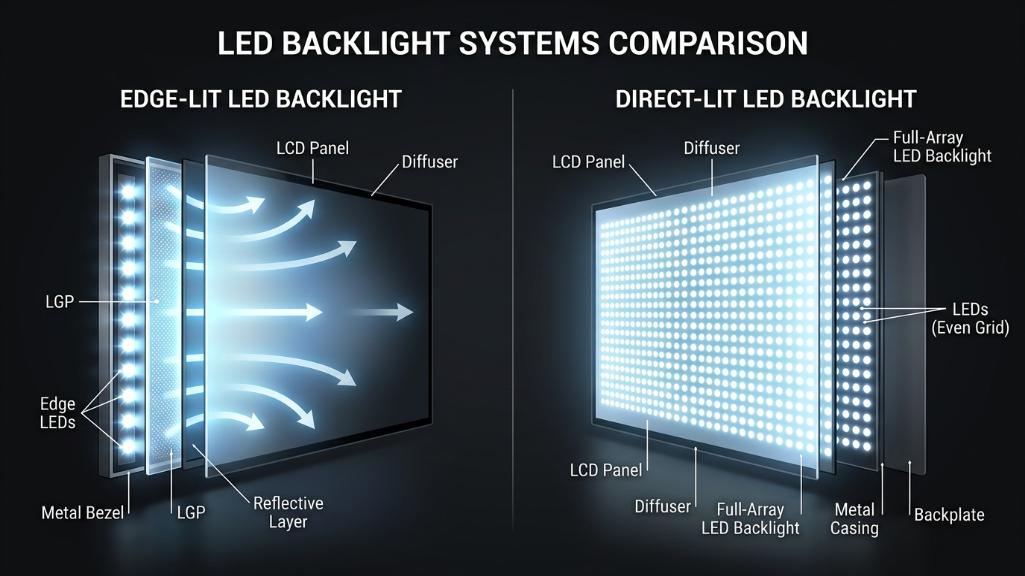
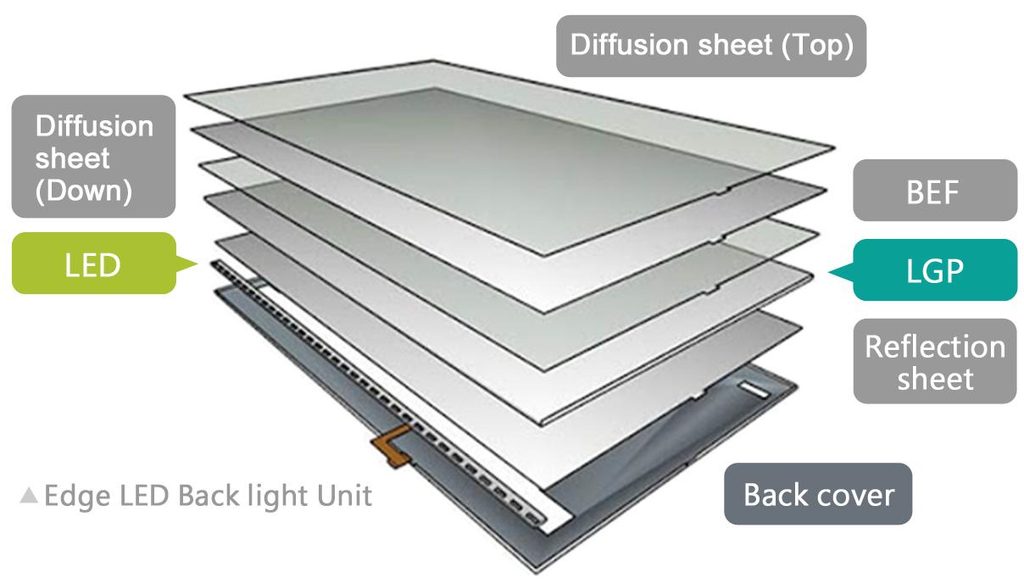
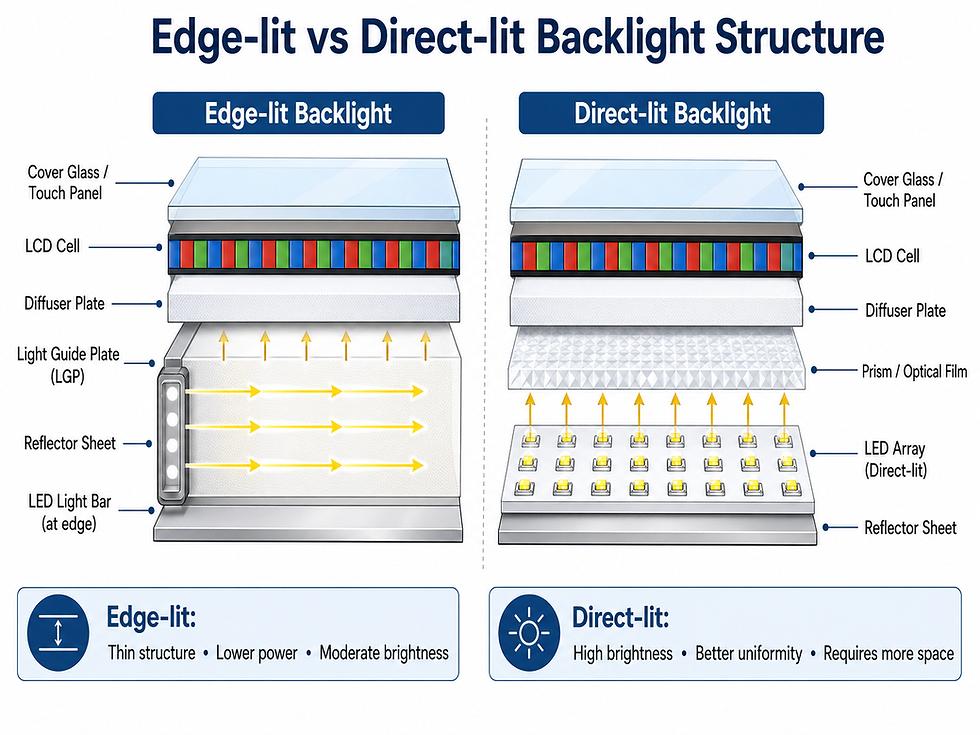
The principal components include:
- LED light sources: Generate the light required to illuminate the LCD panel.
- Light Guide Plate (LGP): Distributes light from edge-mounted LEDs across the display area.
- Reflector: Redirects otherwise lost light toward the display to improve optical efficiency.
- Diffuser films: Distribute illumination evenly and reduce visible LED hot spots.
- Brightness Enhancement Films (BEF): Redirect light to improve luminance within selected viewing angles.
- LED driver electronics: Regulate LED current and control luminance and dimming.
- Thermal management components: Transfer heat away from LEDs and associated electronics.
- Mechanical housing: Maintains optical alignment and protects the backlight assembly.
Together, these components determine the optical efficiency, thickness, brightness uniformity, power consumption, and reliability of the backlighting system.
How Does an AMLCD Backlight Work?
The operation of an AMLCD backlight begins when electrical power is supplied to the LED driver circuitry.
The LED driver regulates current through the LEDs, generating light at the required intensity. Depending on the backlight architecture, this light is either injected into a light guide plate or emitted directly toward the LCD.
Optical films distribute and shape the illumination before it enters the LCD panel.
The liquid crystal cells electronically regulate the transmission of this light through each pixel, producing the displayed image.
Backlight brightness can be adjusted by controlling the LED current, using pulse-width modulation (PWM), or combining both techniques.
Some advanced display systems also incorporate ambient light sensors to automatically adjust luminance in response to surrounding lighting conditions.
What Are the Important Performance Specifications of an AMLCD Backlight?
Backlight performance is evaluated using several optical, electrical, and environmental parameters.
| Parameter | Description |
| Luminance | Light output, usually measured in cd/m² or nits |
| Brightness uniformity | Consistency of illumination across the display area |
| Dimming ratio | Ratio between maximum and minimum controllable brightness |
| Color temperature (CCT) | Appearance of white illumination, expressed in Kelvin |
| Spectral power distribution | Optical energy emitted at different wavelengths |
| Power consumption | Electrical power required to operate the backlight |
| Luminous efficacy | Visible light output per electrical watt |
| Thermal performance | Ability to maintain LED performance under operating temperatures |
| LED lifetime | Expected operating duration before a defined reduction in light output |
| NVIS compatibility | Compliance with applicable night vision spectral and luminance requirements |
The final display luminance depends on the backlight output and the optical transmission efficiency of the entire AMLCD assembly.
Why Is Backlight Technology Important for Cevians Displays?
Cevians develops customized display solutions for applications where conventional commercial LCD performance may not satisfy operational requirements.
The backlighting system can be engineered or modified to optimize a display for the customer’s environment, visibility requirements, electrical interfaces, and applicable performance standards.
Important considerations for Cevians applications include:
Sunlight readability: High-efficiency LED illumination enables increased display luminance for outdoor and cockpit applications.
Wide-range dimming: Controlled brightness adjustment supports operation under both intense daylight and low ambient light conditions.
NVIS compatibility: Spectrally controlled illumination can be integrated with specialized filters to support MIL-STD-3009 requirements for applicable military aviation programs.
Thermal optimization: Appropriate LED selection, electrical drive conditions, and heat dissipation help sustain performance under demanding temperatures.
Optical customization: LED selection, light guides, diffusers, and brightness enhancement films can be optimized to achieve specific illumination and viewing characteristics.
Long-term availability: Backlight design considerations can support product lifecycle management, component replacement, and long-term sustainment of aerospace and defense displays.
Why Choose a Customized AMLCD Backlight?
Standard commercial AMLCD backlights are generally optimized for cost, compact construction, and typical consumer or industrial operating environments.
A customized backlight allows greater control over important system parameters.
Higher brightness: Optical and electrical optimization can increase display luminance for sunlight-readable applications.
Improved uniformity: Tailored light guides and diffusers minimize visible brightness variations.
Extended operating temperature: Appropriate LED selection, drive conditions, and thermal design support operation in demanding environments.
Precise dimming: Specialized control electronics can provide an extended brightness adjustment range for mission-critical applications.
NVIS performance: Optimized LED emission spectra and optical filtering can reduce unwanted near-infrared emissions and support night vision compatibility.
Electrical integration: Backlight drivers can be adapted to customer power architectures, control signals, and system monitoring requirements.
Enhanced reliability: Conservative LED operating conditions, thermal management, and environmental validation can improve long-term performance.
Lifecycle support: Customized designs can facilitate configuration control and management of obsolete components throughout extended product lifecycles.
What Are the Limitations of AMLCD Backlighting?
Although LED backlights offer significant advantages, several technical challenges must be considered.
- High-brightness backlights generate heat that requires effective thermal management.
- Increasing LED drive current may reduce efficiency and accelerate lumen depreciation.
- Poor optical design can produce brightness nonuniformity, light leakage, or visible LED hot spots.
- Wide-range dimming can introduce flicker if the driving electronics are not properly designed.
- LED spectral variations may affect white point, color reproduction, and NVIS performance.
- High electrical switching frequencies and LED drive currents can create electromagnetic interference requiring mitigation.
- Greater luminance generally increases electrical power requirements unless efficiency is improved.
Optimizing these characteristics requires a balanced approach to optical, electrical, thermal, and mechanical design.
How Does Cevians Support Backlight Integration and Customization?
Cevians’ capabilities in optical engineering, display electronics, mechanical integration, and rugged display manufacturing support the development of specialized AMLCD solutions.
Depending on customer requirements, these activities may include selecting suitable LED technologies, evaluating light guide and optical film configurations, integrating LED drivers, developing brightness controls, incorporating optical filters, and validating assembled display performance.
Backlight customization may be combined with other Cevians display technologies, including optical bonding, EMI shielding, anti-reflective treatments, ruggedization, and integrated display electronics.
This approach enables the development of display assemblies tailored to aerospace, defense, medical, and industrial applications rather than relying exclusively on the standard performance of commercial LCD modules.
