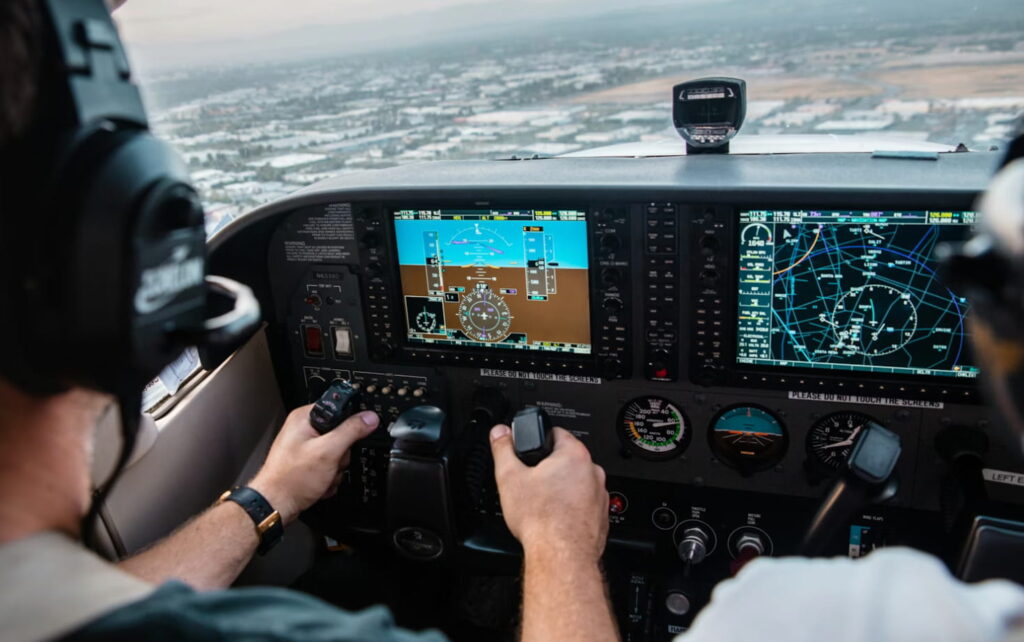
Avionic display systems are a core component of modern aircraft architectures, forming the principal human–machine interface (HMI) between flight crews and increasingly cohesive, automated avionics systems. From Primary Flight Displays (PFDs) and Multifunction Displays (MFDs) to Head-Up Displays (HUDs) and in-flight data systems, displays have shifted from passive indicators to safety-critical subsystems that directly enable flight control, mission execution, and situational awareness.
According to Technavio, the global avionics display market is expected to grow by about 1.41 billion USD from 2025 to 2029, with a compound annual growth rate (CAGR) of 4.5%. This expansion is largely attributed to the growing adoption of digital cockpit architectures, rising regulatory safety requirements, and increased automation in both civil and military aviation sectors.
Avionic Display Architectures Across Mission, Flight, and Support Functions
Modern avionics integrate several classes of display systems, each designed to meet distinct operational and safety requirements:
- Primary Flight Displays (PFDs) providing safety-critical flight parameters such as attitude, airspeed, altitude, and navigation cues.
- Multifunction Displays (MFDs) aggregating navigation, propulsion, systems monitoring, weather, and mission data.
- Intelligence, Surveillance, and Reconnaissance (ISR) displays supporting the collection, processing, visualization, and dissemination of sensor data related to threats, adversary activity, and operational environments.
- Maintenance, caution and warning, and cabin management displays enabling aircraft health monitoring, fault isolation, and crew/passenger interface functions.
These displays are tightly integrated with flight management systems, sensor fusion engines, and avionics data networks, making them integral to both real-time decision-making and long-term mission effectiveness.
Core Display Technologies
Avionic display technologies must satisfy performance, reliability, and environmental requirements that significantly exceed those of commercial or industrial display systems.
- Liquid Crystal Display (LCD) technology remains the dominant solution in certified avionics due to its maturity, predictable aging behavior, and established qualification pathways.
- Micro-LED technology represents a promising emerging option, offering inherently high contrast, brightness, and reliability; however, current limitations in pixel density, manufacturing scalability, and cost prevent near-term adoption in certified avionics platforms.
- Organic Light-Emitting Diode (OLED) displays have not achieved widespread acceptance in avionics applications due to their susceptibility to harsh environmental conditions and fundamental limitations in static image use cases, including image retention and long-term luminance degradation.
Key performance drivers for avionic displays include sunlight readability, high contrast ratio, wide viewing angles, low latency, deterministic behavior, and robust thermal management, all of which must be maintained across extended operating lifetimes and extreme environmental conditions.
Challenges and Looking Forward
Despite favorable market growth projections, the avionics display sector continues to face challenges associated with high certification costs, extended development and qualification cycles, and the requirement for specialized multidisciplinary engineering expertise. Achieving an optimal balance between performance, mass, power consumption, thermal dissipation, and lifecycle cost, while complying with rigorous regulatory and safety standards, remains a central design constraint.
Looking forward, the rapid development of autonomous and highly automated vehicles is expected to influence future cockpit architectures. However, current industry roadmaps do not indicate significant architectural disruption within the next five years. Emerging eVTOL platforms, which are expected to enter service initially in unmanned or minimally crewed configurations, generally assume the continued need for certified cockpit display environments for at least the next decade. This period is viewed as necessary to accumulate sufficient operational reliability and safety data before fundamentally re-evaluating display architectures in piloted aircraft.
Conclusion
Even as aircraft systems become more autonomous, the need for deterministic, certified, and human-centered avionic display environments remains unchanged. Conventional avionic display systems will continue to anchor cockpit architectures through the 2030s, providing the clarity, reliability, and situational awareness required for mission success. Cevians brings advanced optical and display engineering expertise to help defense platforms meet these demands, enabling mission-ready performance in the most demanding operational environments.

