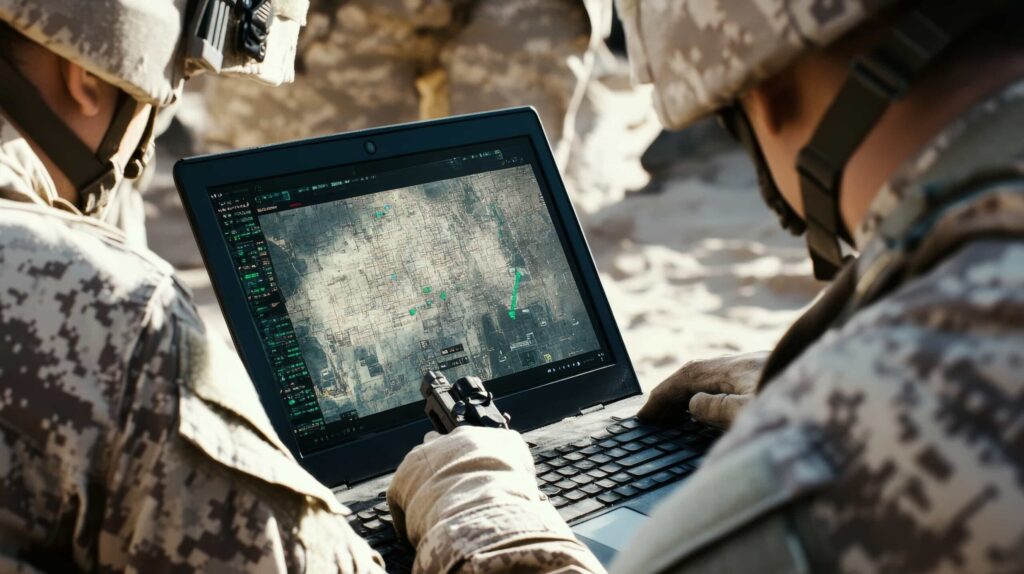
At 30,000 feet, a fighter pilot banks into the sun and their primary flight display vanishes, washed out by 100,000 lux of ambient light flooding the cockpit. The instinctive solution, to simply increase brightness, not only fails but can actually make the problem worse. The real battle for sunlight readable displays is not won by adding more photons. It is won by preventing the wrong photons from ever reaching the pilot’s eye.
The Challenge: Extreme Ambient Light
Monitor and displays used in aerospace and defense systems must overcome extreme ambient illumination that can exceed 100,000 lux on tarmac or at altitude. Two dominant optical challenges govern readability: specular reflection and diffuse reflection.
Specular reflection acts like a bathroom mirror. It preserves angle of incidence and creates glare “hot spots.” Diffuse reflection behaves like light scattered by a frosted window. It scatters light in multiple directions due to micro-surface roughness, elevating the black-level floor and reducing perceived contrast.
Understanding the Enemy: Specular vs Diffuse Reflection
Specular reflection (Fresnel reflection) originates at interfaces where there is a refractive index mismatch (air→glass, glass→polarizer). The reflection intensity changes with viewing angle and polarization state. In cockpit environments, this can reflect sun, helmets, consoles, or canopy structure directly into the pilot’s eye, resulting in functional blindness to display content.
Diffuse reflection stems from surface micro-texture and subsurface scattering. Even when glare is not angle-aligned, scattered photons increase the luminance of nominally dark pixels. The observer perceives blacks as dark gray, significantly degrading contrast.
Mathematically, perceived contrast under high ambient light is expressed as:
(Bright Pixel + Reflected Ambient Light)
C_perceived = ───────────────────────────
(Black Level Leakage + Reflected Ambient Light)
Even when display luminance (L_on) increases, the ambient-reflected component affects both numerator and denominator, but it disproportionately washes out blacks (L_black), collapsing effective contrast.
Why “More Nits” Alone Isn’t t the Answer for Sunlight Readable Displays
A common but flawed approach to achieving sunlight readability is to simply increase backlight power to drive extreme brightness, often targeting >1,500–2,000 nits. While this can improve bright-pixel visibility, it does not preserve dark-pixel depth:
- Black-level washout: As luminance increases, pixel extinction ratios of the LCD stack do not scale, leading to a fixed optical leakage. Higher luminance increases the visibility of the leakage, making dark pixels appear milky.
- Thermal burden: More LED power directly raises display temperature. This increases system cooling requirements, fan acoustic noise, and failure rates of LED drivers and display timing controllers.
- Heat-induced reliability risk: Cockpit stacks are often sealed or conformally coated. Sustained high temperature derates adhesives like OCA, damages polarizers, and accelerates color shift or delamination.
- Power efficiency conflict: Higher brightness backlights reduce mission endurance in dismounted or vehicle-powered applications.
Ultimately, increasing brightness without controlling reflection is a losing arms race with physics.
The Superior Weapon: Optical Stack Reflection Management
The strongest gains in sunlight readability are achieved not by forcing photons from the backlight, but by stopping photons from entering the viewing path in the first place. This is done by managing the reflection layers in the optical stack using:
- Antireflection (AR) coatings on outer glass: Multilayer thin-film stacks engineered to cancel Fresnel reflections via destructive interference.
- Index-matching optical layers: Adhesive refractive index optimization between cover lens and air interface.
- Micro-mesh or transparent conductive layers: For EMI-shielded displays, careful integration of optical-safe conductors (ITO, embedded micro-mesh) avoids Moiré and angle-dependent scattering.
- Hydrophobic and oleophobic surface top-coats: Reduce diffuse scattering from smudges, sand abrasion, or oily deposits.
Historically, military sunlight readability performance have been measured in accordance with MIL-L-85762A, which define optical requirements for reducing reflectance on aircraft transparencies, establishing a benchmark for cockpit display AR targets.
Optimizing for the Pilot: Angle-Dependent Thin-Film Deposition
In a fighter or rotary cockpit, the user’s eye-box is not random, it is constrained by seat, helmet, NVG, and instrument panel geometry. This allows coatings to be directionally optimized.
Angle-Dependent AR optimization is achieved using oblique-incidence thin-film deposition and modeling of spectral reflectance minima relative to expected eye position. Unlike consumer coatings, which optimize for normal incidence, aerospace AR stacks bias reflectance suppression toward 15°–40° depending on aircraft glass rake and pilot posture.
By intentionally depositing at a controlled angle, the engineered optical thickness aligns the AR performance notch to the observer eye position when the display is installed. This maximizes perceived contrast without increasing backlight power and maintains deep blacks, especially under HUD or NVG viewing conditions.
Conclusion
In the end, sunlight readability is not a brightness problem but an optical discipline problem. Displays fail in extreme light not because they cannot emit enough photons, but because uncontrolled reflections allow ambient photons to overwhelm contrast at the eye. By treating specular and diffuse reflection as the true adversaries and engineering the optical stack to suppress them through AR coatings, index matching, and angle optimized thin film deposition, designers can preserve deep blacks, stable contrast, and pilot legibility without escalating power, heat, or risk. In high performance cockpits, the winning strategy is not brute force luminance, but precision control of the light that never should have been seen in the first place.
In high-performance cockpits, the decisive advantage comes not from brute force luminance but from precise control of unwanted light within the optical stack. Cevians’ is the industry leader in readable display design, where engineered reflection management delivers lasting contrast, reliability, and legibility under the most demanding conditions.
Discover how Cevians can help support the success of your next mission and contact us today.

