Every millisecond counts. For military operators, latency is not simply a performance specification, it is a mission-critical requirement.
When a driver depends on camera imagery to navigate an armored vehicle through confined spaces, every millisecond of delay directly affects vehicle control, situational awareness, and crew safety. Likewise, remote weapon stations, perimeter surveillance systems, and aerospace mission displays require video processing that responds in real time without perceptible lag.
Commercial graphics processors often prioritize image quality, compression, or multimedia features at the expense of latency. In contrast, Cevians’ PixelMaster™ was engineered to deliver deterministic, ultra-low-latency video processing for applications where speed cannot be compromised.
Optimized for Driver Vision Enhancement (DVE)
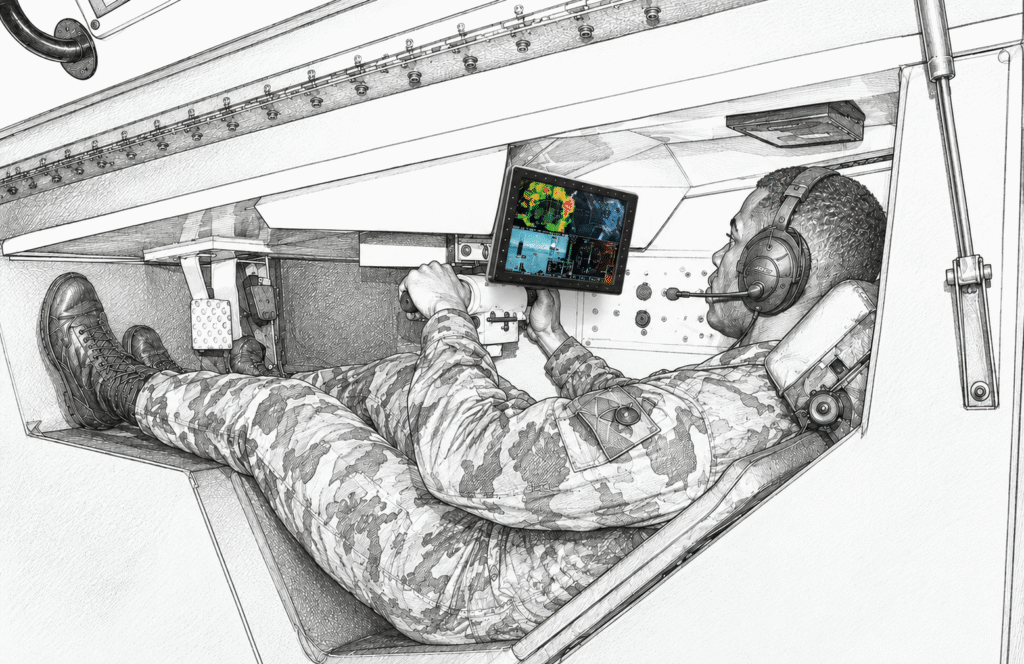
Unlike conventional industrial video cards that primarily target factory automation or commercial embedded systems, PixelMaster hasDriver Vision Enhancement (DVE) systems represent one of the most demanding video applications in military ground vehicles. Operators rely entirely on electronic imagery during night operations, brownout conditions, smoke, or enclosed-hatch driving, where even modest delays between camera capture and display degrade handling and increase workload.
PixelMaster incorporates a dedicated low-latency processing path specifically intended for these applications. Rather than routing every video stream through identical processing pipelines, critical channels can bypass unnecessary processing stages, allowing video to reach the display with exceptionally low delay while maintaining image integrity. The result is near real-time rendering suitable for demanding driver vision applications.
Overlay Information Without Sacrificing Speed
Historically, adding graphical overlays often increased processing latency.
Military operators, however, require both immediate video and continuous presentation of operational information. PixelMaster solves this challenge by allowing ultra-low-latency video to coexist with programmable graphical content including vehicle status, navigation information, warning annunciations, crosshairs, text messaging, mission symbology, sensor identification, and operator prompts. This architecture enables real-time video while simultaneously displaying mission-critical information without compromising responsiveness.
More Than a Video Processor
PixelMaster’s processing resources extend well beyond video management, providing enough computational capability to integrate numerous embedded control functions directly within the system.
These capabilities include: serial communication management, vehicle network interfacing, Human-Machine Interface (HMI) control, sensor acquisition, backlight management, health monitoring, display diagnostics, and system configuration management.
Consolidating these onto a single hardware platform reduces complexity while minimizing the number of independent electronic modules required within the vehicle.
Software That Adapts to the Mission
One of PixelMaster’s greatest strengths is its software architecture. Rather than forcing developers into fixed operating modes, the platform supports user-defined software applications tailored to each program’s operational requirements. Developers can implement custom display logic, communication protocols, sensor processing, HMI behavior, graphics generation, control algorithms, and platform-specific functionality while leveraging the underlying video processing engine. This flexibility transforms PixelMaster from a fixed-function video card into an application-specific embedded computing platform.
Supporting System Integration
Because many peripheral functions execute directly on PixelMaster, system integration becomes significantly simpler. Instead of distributing functionality across multiple processors, communication modules, and controller boards, many responsibilities can be centralized within one rugged platform, reducing wiring complexity, lowering power consumption, improving reliability, cutting the number of interfaces to validate, simplifying software integration, and easing long-term maintenance. For vehicle manufacturers and aerospace integrators, this translates directly into reduced program risk and lower lifecycle costs.
Built for Future Capability
Modern defense programs increasingly demand software-defined functionality able to evolve across decades of service. PixelMaster’s programmable architecture enables new operational modes, updated user interfaces, enhanced graphics, additional communication protocols, and expanded processing capabilities through software rather than hardware redesign. As missions evolve, the same hardware platform continues to adapt.
Performance Without Compromise
Military display systems demand more than high image quality, they demand deterministic performance, rugged reliability, and complete flexibility.
By combining an ultra-low-latency video pipeline with advanced graphics generation, embedded processing, and extensive software programmability, PixelMaster enables designers to develop sophisticated display systems that satisfy the demanding requirements of modern military ground vehicles and aerospace platforms. When operators depend upon instantaneous visual information to make life-critical decisions, every millisecond matters. PixelMaster was engineered so those milliseconds never become a limitation.

