The development of a custom Active-Matrix Liquid Crystal Display (AMLCD) for aerospace, defense, industrial, or medical applications is a multidisciplinary engineering effort that extends well beyond conventional commercial display design. Unlike commodity panels, custom AMLCD solutions are driven by deterministic performance requirements, extended environmental operating ranges, long service life, and strict qualification and certification constraints.
At the core of the display subsystem lies the AMLCD cell itself, whose optical and electrical characteristics directly define image quality, stability, and lifetime. However, in mission-critical systems, the AMLCD cell cannot be considered in isolation. Its performance is inseparable from the display interface electronics, increasingly implemented as an FPGA-based display interface board (DIB) that provides precise display timing control and electronic health monitoring (EHM).
Discover the key technical requirements associated with the design of a custom AMLCD cell and its tightly coupled FPGA-based electronics, with emphasis on electro-optical performance, stability, reliability, and system-level integrity.
The Anatomy of AMLCD Cell
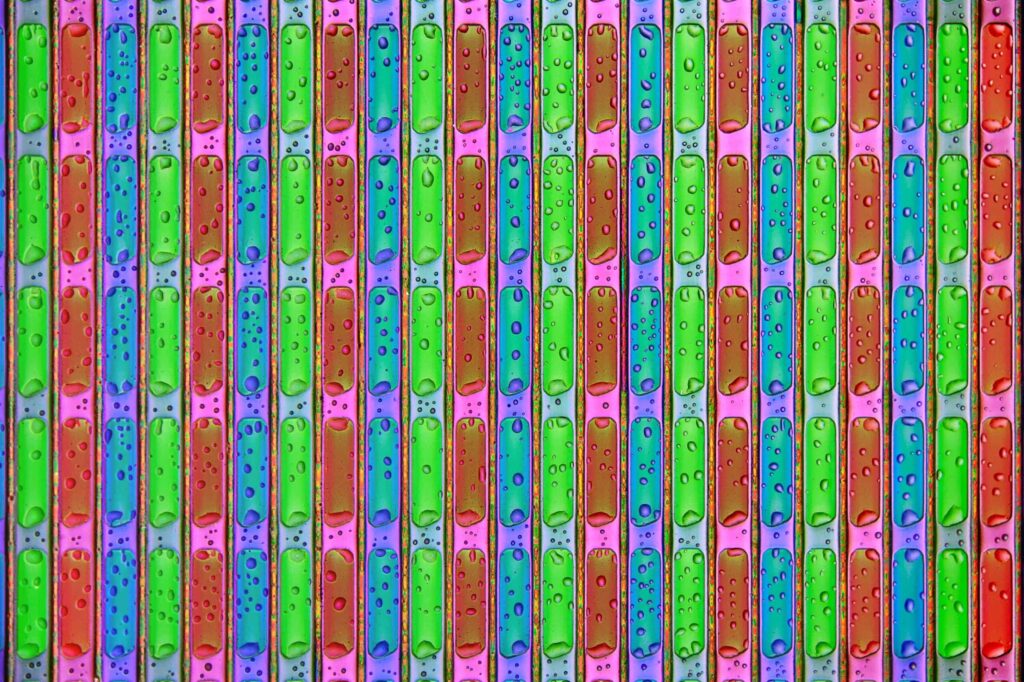
An AMLCD cell consists of two glass substrates bonded together with a controlled cell gap and filled with liquid crystal material. One substrate incorporates the thin-film transistor (TFT) active matrix backplane, while the opposing substrate typically carries the common electrode, color filter (for color displays), and optical alignment layers.
The AMLCD cell does not include the backlight, mechanical housing, or control electronics.
Nevertheless, cell-level design decisions must anticipate downstream integration, as parameters such as operating voltage, timing margins, optical efficiency, and temperature behavior are tightly coupled to the electronics that drive the panel.
Glass Substrate Requirements and TFT Backplane Architecture
Glass Substrate Requirements
Glass selection is fundamental to AMLCD cell stability and yield. Substrates must provide:
- High dimensional stability across temperature
- Tight thickness and flatness control
- Compatible coefficient of thermal expansion (CTE) between top and bottom glass
- Chemical robustness for TFT processing and sealing operations
For rugged or extended-temperature applications, tighter warp and bow limits are often required to maintain uniform cell gap and optical performance over life.
TFT Backplane Technology and Pixel Design
The TFT backplane defines the electrical behavior of the AMLCD cell. Common technologies include amorphous silicon (a-Si), LTPS, and oxide semiconductors such as IGZO. In mission-critical displays, a-Si and oxide TFTs are frequently selected due to predictable behavior and long-term stability.
Pixel architecture must balance:
- Aperture ratio and optical transmission.
- TFT leakage current and threshold stability.
- Storage capacitor sizing for grayscale retention
- Routing of gate and source lines to minimize crosstalk
Static or quasi-static imagery, common in avionics and ISR applications, places particular emphasis on charge retention and DC balance, as image stability is often more critical than raw refresh performance.
Liquid Crystal Mode Selection
Liquid crystal mode selection is one of the most consequential architectural decisions in AMLCD cell design. Common modes include TN, IPS, FFS, and VA, each presenting tradeoffs in contrast ratio, viewing angle, response time, and drive voltage.
For mission-critical applications, IPS and FFS modes are often favored due to superior viewing angle symmetry and grayscale stability, while VA modes may be selected where high contrast and controlled viewing geometry are prioritized.
The chosen LC mode directly influences drive timing, inversion schemes, and voltage margins implemented in the display electronics.
Cell Gap Control and Alignment Layers
Cell Gap Uniformity
The cell gap determines optical retardation, operating voltage, contrast ratio, and temperature sensitivity. Uniformity across the panel is critical to prevent luminance and color non-uniformity.
Cell gap control is achieved through spacer beads or patterned spacers, with tighter tolerances required as pixel pitch decreases. Variations in cell gap must be accounted for in both optical design and electronic drive margins.
Alignment Layers
Polyimide alignment layers establish the initial orientation of the LC molecules. Rubbing direction, pre-tilt angle, and alignment uniformity must be tightly controlled to ensure predictable electro-optical behavior.
For extended-temperature and long-life applications, alignment materials are often tailored to minimize image sticking, slow degradation, and sensitivity to thermal cycling.
Electro-Optical Performance Requirements
AMLCD cell design directly determines:
- Optical transmission and efficiency.
- Contrast ratio and black level.
- Response time across temperature.
- Viewing angle symmetry.
- Grayscale linearity and stability.
These parameters are interdependent and must be optimized holistically. For example, increasing cell gap may improve contrast but increase response time and drive voltage, impacting both electronics design and thermal margins.
FPGA-Based Display Interface Board: Timing and Control
To achieve stable and certifiable operation, custom AMLCD cells are typically driven by a dedicated FPGA-based display interface board. The FPGA provides deterministic generation and control of all panel timing signals, including:
- Pixel clock and synchronization.
- Horizontal and vertical timing.
- Gate scanning sequences.
- Source data alignment.
- Frame and line inversion patterns.
- DC balance control.
Custom AMLCD cells often use non-standard timing parameters that cannot be supported by off-the-shelf display controllers. FPGA implementation allows precise tuning of timing margins to the specific TFT characteristics, LC response behavior, and temperature range of the cell.
Proper timing control is essential not only for image quality but also for long-term panel health, as incorrect inversion or imbalance can accelerate LC degradation and image retention.
Enabling Comprehensive Electronic Health Monitoring (EHM)
In mission-critical systems, the display subsystem must actively monitor its own integrity. The FPGA-based interface board enables comprehensive electronic health monitoring, transforming the AMLCD from a passive component into a managed subsystem. Typical EHM functions include:
- Monitoring of panel bias voltages and supply rails.
- Pixel clock and timing integrity verification.
- Detection of gate or source driver anomalies.
- Temperature sensing at the panel, drivers, and FPGA.
- Verification of correct sequencing and operating states.
- Watchdog supervision and fault reporting.
By correlating electrical signatures with known AMLCD failure mechanisms, such as TFT leakage drift, gate line opens, or abnormal current draw, the system can detect latent degradation before it manifests as visible image artifacts.
Electrical Stability and Image Integrity For Custom AMLCD
Long-term image stability is a defining requirement for AMLCDs used in avionics and defense systems. The combined cell-and-electronics design must ensure:
- DC balance across all operating modes.
- Flicker-free grayscale rendering.
- Stable behavior under static imagery.
- Predictable performance across temperature and lifetime.
The FPGA-based timing engine plays a central role in enforcing these constraints, ensuring that electro-optical stress on the cell remains within conservative limits.
Custom AMLCD Environmental and Reliability Considerations
Custom AMLCD cells are often required to operate over extended temperature ranges and survive aggressive thermal cycling. Design must account for:
- LC viscosity changes at low temperature.
- Seal integrity under thermal stress.
- CTE mismatch between materials.
- Moisture ingress and long-term aging.
Reliability risks include LC degradation, alignment layer wear, TFT threshold shift, and seal failure. Mitigation strategies include conservative voltage margins, optimized LC chemistry, robust sealing processes, and continuous health monitoring via the display electronics.
Manufacturability and Lifecycle Support
Because custom AMLCDs are typically produced in lower volumes, design for manufacturability (DFM) is essential. Cell architecture must align with realistic process windows, yield expectations, and long-term supplier capability.
The FPGA-based interface board further supports lifecycle management by allowing timing updates, compensation for panel revisions, and adaptation to supplier changes without redesigning the entire display subsystem.
Conclusion
The successful development of a custom AMLCD solution requires an integrated approach that treats the AMLCD cell and display electronics as a unified system. Cell-level decisions in glass selection, TFT architecture, LC mode, and alignment directly shape the requirements for timing generation, power management, and health monitoring.
An FPGA-based display interface board is a critical enabler, providing precise timing control, electronic health monitoring, and long-term adaptability. Together, the AMLCD cell and its electronics form a deterministic, reliable, and certifiable display subsystem capable of meeting the demanding requirements of aerospace, defense, and other mission-critical applications.
Cevians develops AMLCDs in accordance with proven guidelines of our manufacturing partner’s capabilities. The AMLCD is designed for specific resolutions, pixel size, color, sizes, finishes, thickness, driving electronics. Contact us today to learn how Cevians’ custom solutions can help your next mission critical AMLCD display.

